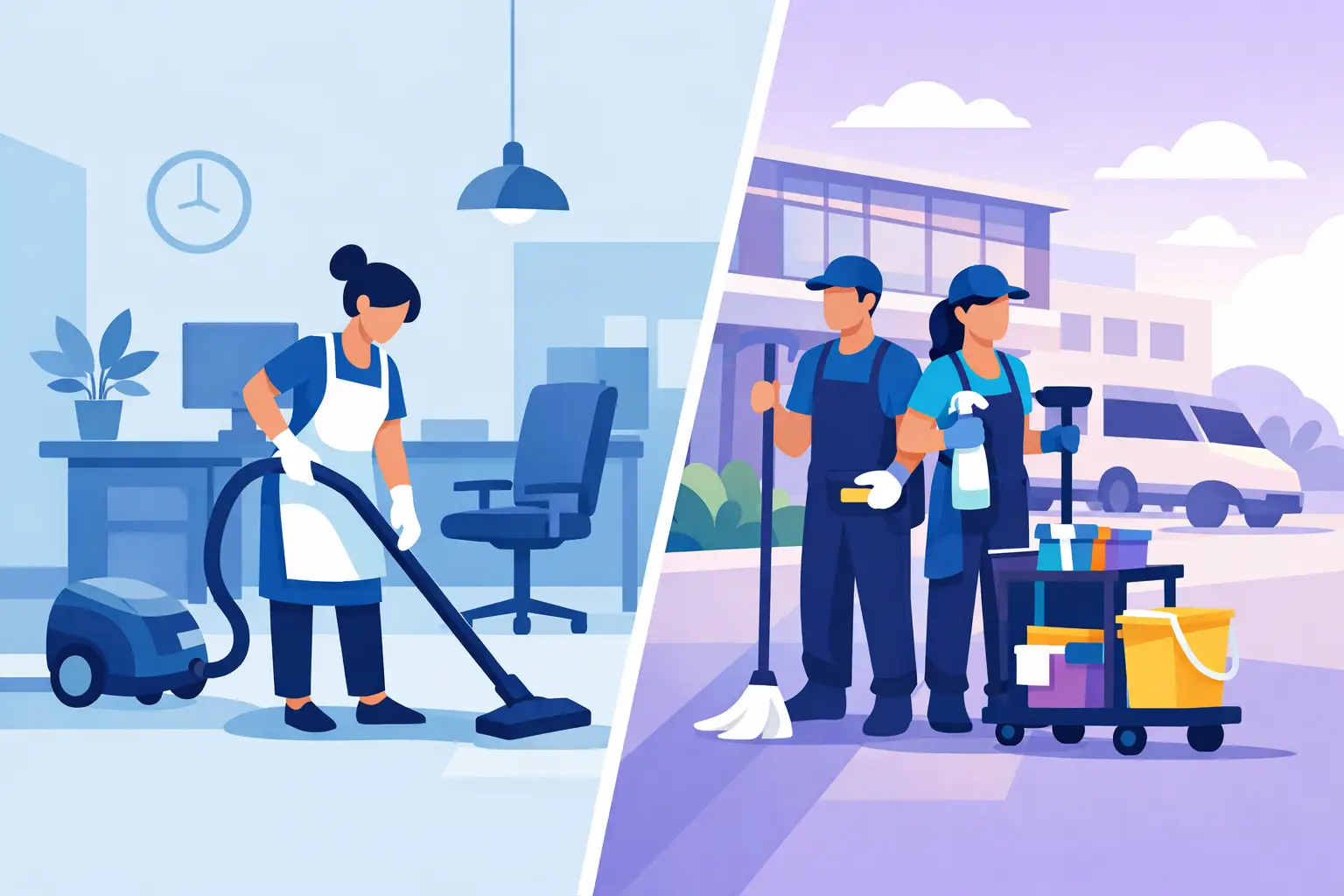
A clean space says a great deal before anyone speaks. In a home, it shapes comfort and routine. In a workplace, it affects staff wellbeing, presentation and first impressions. That is why the question of in house vs outsourced cleaning deserves more than a quick look at hourly rates.
For some households and businesses, keeping cleaning in-house feels like the most direct option. For others, outsourcing brings the consistency, flexibility and professional finish they need. The right choice depends on your space, your standards, your schedule and how much responsibility you want to carry internally.
In house vs outsourced cleaning at a glance
In-house cleaning means the cleaner or cleaning team is employed directly by you or your business. You manage recruitment, training, rotas, absence cover, supplies and quality control. Outsourced cleaning means you appoint a specialist company to deliver the service under an agreed scope, schedule and standard.
Neither model is automatically better in every setting. A small office with light daily use has different needs from a busy household, a managed block, a letting portfolio or a post-construction site. The strongest decision usually comes from looking beyond wages and asking what level of reliability, oversight and specialist capability you actually need.
Where in-house cleaning works well
There are situations where in-house cleaning can make good sense. If you need someone on site throughout the day, or your cleaning tasks are closely tied to wider facilities duties, direct employment can offer convenience. A school, a healthcare setting or a large office with ongoing daytime needs may value having a familiar team embedded in daily operations.
Some businesses also prefer the sense of direct control. You choose who to hire, how they work and how tasks are prioritised. If your premises have very specific routines or security protocols, that level of closeness can feel reassuring.
In a domestic setting, in-house cleaning is less common in the formal employment sense, but some households prefer to rely on one individual they know well. That arrangement can suit people who want continuity and a very personalised routine.
The trade-off is that control comes with admin. Recruitment takes time. Training needs structure. Holiday and sickness cover must be arranged. Supplies need restocking. Standards can drift unless someone is checking details consistently. What looks simple at first often becomes another management task in an already full week.
Why outsourced cleaning appeals to busy homes and businesses
Outsourced cleaning is often chosen for one reason above all: it reduces friction. Instead of building and supervising the function yourself, you hand responsibility to a professional team with the tools, processes and cover already in place.
That matters for businesses where presentation and hygiene are non-negotiable, but internal time is limited. It also matters for landlords, letting agents and homeowners who need dependable results without chasing schedules, products or last-minute replacements.
A specialist cleaning company can usually scale more easily around your needs. If you require extra visits during peak periods, a deep clean before guests arrive, end of tenancy support, post-build cleaning or carpet and upholstery care, those services are already part of the model. You are not trying to stretch one person beyond their role.
There is also the quality factor. Professional cleaners work to repeatable standards. They know how to treat different surfaces correctly, how to clean efficiently and how to spot issues before they become bigger problems. When the service is managed well, the result is not simply tidier rooms. It is a more polished, healthier and more reliably maintained environment.
Cost is not as simple as the hourly rate
Cost is often the first comparison people make, but it is rarely the most accurate one. In-house cleaning may appear cheaper if you only compare an hourly wage with a contract price. The real figure is broader.
With in-house arrangements, you may need to account for recruitment time, payroll, pension contributions, holiday pay, sick pay, insurance, training, equipment, consumables and supervision. If someone leaves, there is another round of hiring and another period of disruption. If standards drop, the hidden cost shows up in complaints, missed details and time spent putting things right.
Outsourced cleaning typically bundles much of that into one service cost. You are paying for labour, but also for management, accountability, cover, equipment, products and operational consistency. For many clients, especially smaller businesses and busy households, that makes budgeting easier and outcomes more dependable.
Of course, there are cases where in-house can be cost-effective, particularly at scale. If you have a large site with constant cleaning demand, a directly employed team may be justified. But if your needs vary, or if you do not want cleaning to become an internal function to run, outsourcing often delivers better value rather than simply a lower headline price.
Control versus accountability
One of the biggest concerns in the in house vs outsourced cleaning debate is control. People often assume in-house means better control because the cleaner works directly for them. That can be true in a narrow sense, but it is not always true in practice.
Direct control only works well if someone has the time and skill to manage performance properly. Without clear checklists, feedback, training and follow-up, control becomes informal and inconsistent. The standard then depends too heavily on one individual.
With outsourced cleaning, day-to-day control is lighter, but accountability can be stronger. A reputable provider works to a clear brief, agreed outcomes and a service standard that can be reviewed. If there is a problem, you are not left to resolve it alone. There is a company behind the service, with systems in place to respond, improve and maintain continuity.
That difference matters for offices, managed properties and tenancies where cleaning quality affects reputation. It also matters in homes where reliability is part of the value. Clients usually do not want another task to monitor closely. They want to feel confident the space will be cared for properly.
Flexibility and specialist cleaning needs
Routine cleaning is only part of the picture. Many properties need occasional services that go far beyond a standard weekly tidy. Ovens need degreasing. Carpets need refreshing. Upholstery collects dust and allergens. Windows require the right approach. End of tenancy and post-construction cleaning demand precision and stamina.
This is where outsourced cleaning often has a clear advantage. Specialist teams, methods and equipment are already available. You can move from maintenance cleaning to deeper restorative work without sourcing multiple suppliers or expecting one in-house person to handle everything.
For landlords and letting agents, this flexibility is especially valuable. A property may need a regular clean between viewings, then a detailed end of tenancy clean, then carpet or sparkle cleaning before handover. For office managers, seasonal deep cleans or out-of-hours work can be arranged without reshaping internal staffing.
In South-West England, where many clients manage a mix of homes, holiday lets, offices and trade premises, flexibility is not a luxury. It is often what keeps operations smooth.
When outsourced cleaning is the stronger choice
If cleaning needs to happen reliably without adding to your workload, outsourcing is usually the stronger option. It suits busy homeowners who want more time back, businesses that want a consistently polished environment, and property professionals who need quick turnarounds with less risk.
It is also the better fit when quality matters visibly. Client-facing offices, managed rentals, post-build properties and family homes all benefit from trained cleaners who work with care, proper products and a clear standard. A well-run service gives you more than clean rooms. It gives you confidence.
That is why many clients choose a professional partner such as Blueglade Cleaning. The value is not only in the result on the day, but in the ease of knowing the service is organised, insured, flexible and built around your needs.
Making the right decision for your property
If you are weighing in-house against outsourced cleaning, start with three honest questions. How much management time can you realistically give it? How important is cover and consistency? And do your cleaning needs stay simple, or do they change across the year?
If you have the scale, structure and internal oversight to run cleaning well, an in-house model may suit you. If you want dependable standards, less admin and access to wider expertise, outsourcing is often the more practical and more reassuring choice.
A cleaner space should not create more work behind the scenes. The best arrangement is the one that protects your time, upholds your standards and keeps your home or workplace ready for whatever comes next.
Leave a Reply